Customer retention: reviews, followers, promo codes and blocked customers
In short
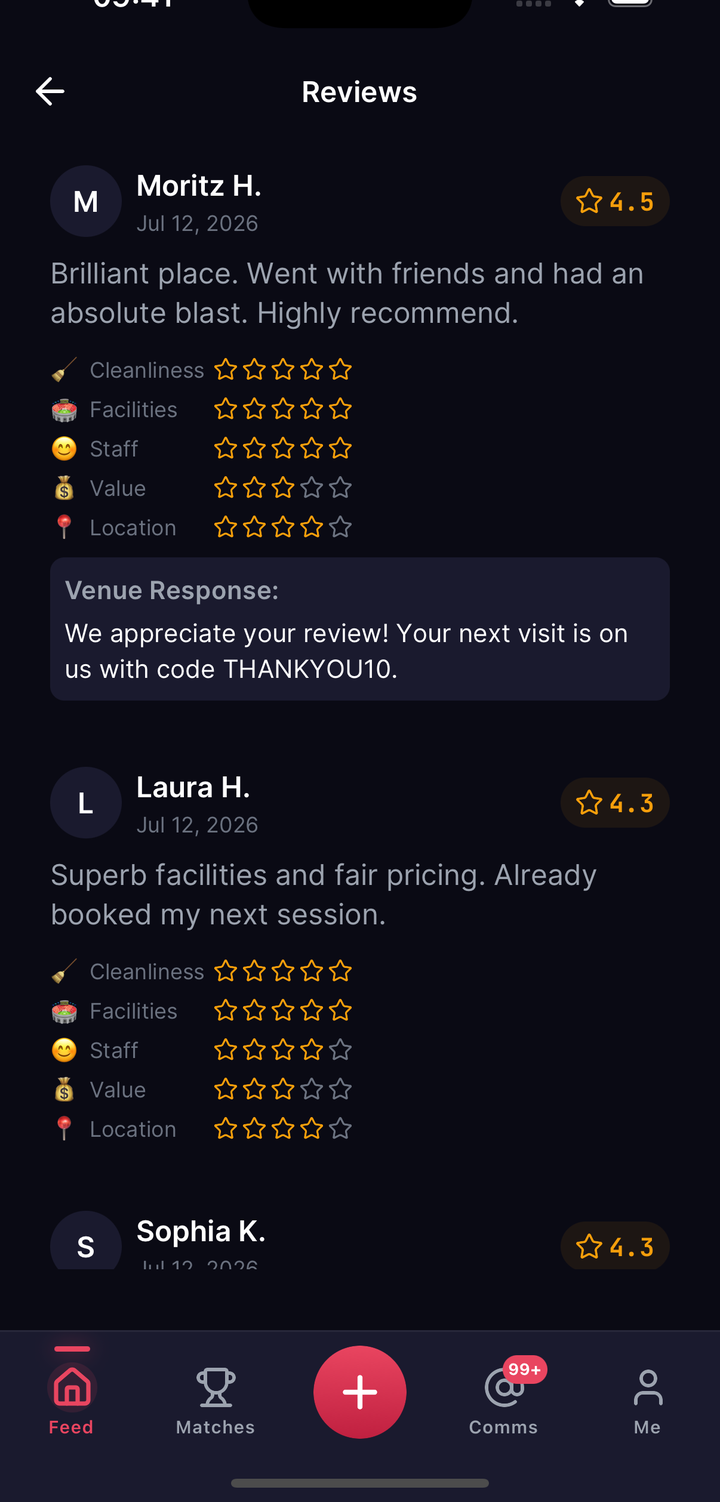
- Players review after a completed booking. You can reply publicly, and abuse can be hidden with a stated reason.
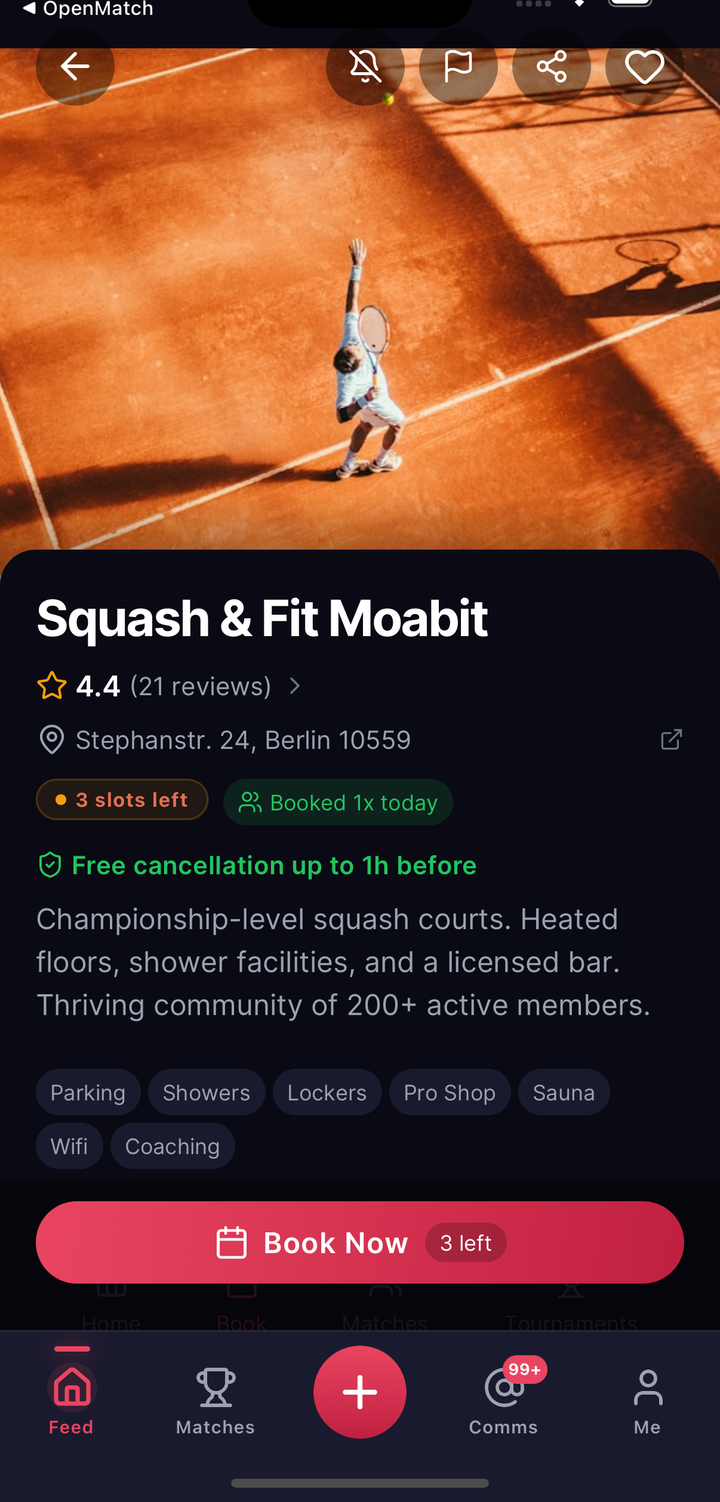
- "Follow" (the bell) is not the same as "Favourite" (the heart): only followers get push messages about your tournaments.
- Promo codes can be advertised publicly or kept private. And problem customers can be blocked per venue, with the reason in the audit trail.
Reviews: visible, answerable, moderatable
A player can only review a venue once their booking is marked as done, and only within a 14-day window afterwards, otherwise the review lapses. Five sub-scores (cleanliness, facilities, staff, value, location) produce an overall score. Reading and moderating reviews works on every plan; replying publicly to a review is a Growth feature, so on Starter you see and report reviews and the reply field unlocks with Growth.
When a review looks obviously unfair, abusive or fake, you report it, and an admin can then hide or flag it. That is only possible with a stated reason (at least 5 characters, at most 500), which is logged permanently: who changed what, when, and why. No silent deletions. legal review pending Whether and to what extent a review is legally protected as an expression of opinion is governed in case of doubt by the Terms; the Terms are what binds.
Follow versus favourite: two different things
This is where operators most often get confused: the heart and the bell look similar but mean completely different things.
| Favourite (heart) | Follow (bell) | |
|---|---|---|
| Meaning | the player's personal bookmark | a subscription to push messages about your tournament announcements |
| What you notice | nothing, it is purely the player's own shortlist | you reach these players directly the moment you announce a tournament or open registration |
| Toggle | independent of each other, both on the venue page | independent of each other |
A player can favourite your venue without following, and the other way round. What matters to you above all is the follower count: it is your built-in reach for every tournament announcement, with no extra advertising at all.
Promo codes: public or private
Promo codes are a Growth feature. In the dashboard you create a discount code, 15% off the next booking capped at 100 redemptions, say. One switch decides how visible the code is:
| Public | Private | |
|---|---|---|
| Visibility | automatically in the "Deals & offers" carousel in the customer app | listed nowhere, redeemable only by whoever knows the exact code |
| Typical use | reach for a campaign, promoted for free | making good after a complaint, say, or a deal for one particular partner |
| Redemption limit | capped by your redemption limit (max. 50 uses, for example) | capped in exactly the same way |
The public/private switch runs independently of the active/inactive switch: you can deactivate a code at any time without changing its visibility, and the other way round. A public code is your simplest form of free marketing reach; a private code is your tool for the individual case.
Blocking customers
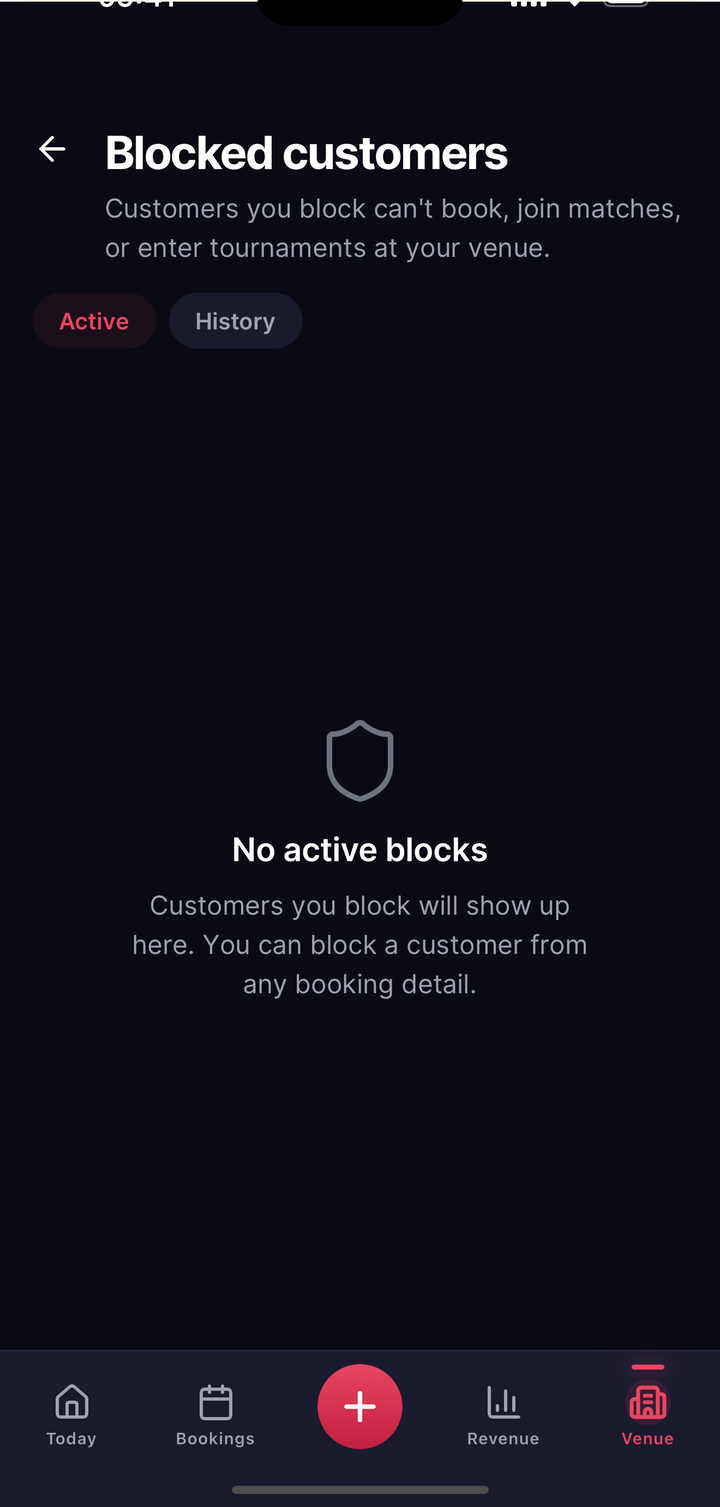
Repeated no-shows, an argument with your staff, abuse: when a customer becomes a problem for you, you can block them for your venue. Future booking attempts, match joins and tournament registrations at that location are then refused automatically. A reason is mandatory and lands in the audit trail, traceable for you and, in case of doubt, for openmatch.
One thing to keep apart: this is not the same as two players blocking each other. A player block is purely social and between two users; your venue block is a commercial decision that applies only to your location. The blocked customer sees a generic message and never learns which venue blocked them. legal review pending Here too: the details of blocking reasons and their limits are governed by the Terms, and the Terms are what binds.